A Comprehensive Comparison of Major NAD+ Precursors
What is NAD+? Why is it so important?
NAD+ (nicotinamide adenine dinucleotide) is a vital coenzyme present in every living cell. It is central to numerous critical biological processes, including energy metabolism, DNA repair, gene expression, and cellular stress resistance.As we age, NAD+ levels in the body decline significantly, a phenomenon closely linked to numerous age-related diseases such as neurodegenerative disorders, metabolic conditions, and cardiovascular diseases. Consequently, boosting NAD+ levels through supplementation with NAD+ precursors has emerged as a prominent research focus in anti-aging and health management. What are the NAD+ precursors? NAD+ is primarily synthesized in the body through various precursors. These precursors serve as the “raw materials” for NAD+ synthesis. The main precursors include:- Niacin (Nicotinic Acid)
- Nicotinamide (Niacinamide)
- Tryptophan
- Nicotinamide Riboside (NR)
- Nicotinamide Mononucleotide (NMN)
- Translated with DeepL.com (free version)
Below are detailed descriptions of the five primary precursors:
- 1. Niacin As a form of vitamin B3, it synthesizes NAD+ via the Preiss-Handler pathway. Widely present in meat, fish, and nuts. High doses (>50-100mg) cause skin flushing and may pose hepatotoxic risks, making it less preferred for NAD+ supplementation and more commonly used in clinical lipid-lowering therapy.
- 2. Nicotinamide The amide form of niacin, which can be recycled via the salvage pathway for NAD+ synthesis. Common in foods and vitamin B supplements. It lacks the flushing side effect but, at high concentrations, inhibits NAD+-dependent deacetylases (like SIRT1), potentially counteracting their benefits. Currently more prevalent in skincare products.
- 3. Tryptophan An essential amino acid that synthesizes NAD+ via the complex kynurenine pathway. Common in meat, cheese, and eggs. This pathway is inefficient and its intermediates may be neurotoxic, serving only as a “backup” route when other precursors are insufficient.
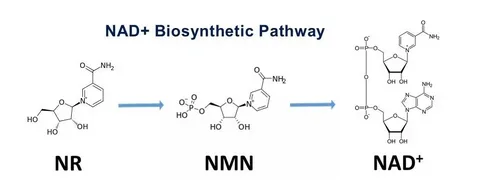
- 4. Nicotinamide Riboside (NR) A form of vitamin B3, it is a direct precursor to NAD+, first converting to NMN within cells before generating NAD+. It exists in trace amounts in milk and yeast but is now commonly available as a supplement (e.g., the patented ingredient Niagen®). Studies confirm its high efficiency in boosting NAD+ levels with good safety, though most is metabolized into nicotinamide in the liver after oral intake.
- 5. Nicotinamide Mononucleotide (NMN) A direct precursor to NAD+, NMN is closer to NAD+ than NR. It exists in foods like edamame and broccoli but at extremely low levels, making supplementation the primary source. Animal studies indicate significant potential for anti-aging and metabolic improvements, and early human trials confirm its safety and efficacy, though long-term human data is still being collected. Its absorption mechanism and bioavailability were once points of contention, but recent research has progressively clarified these aspects.
| Precursor Name | Introduction & Pathway | Key Advantages | Major Drawbacks & Challenges | Primary Applications & Current Status |
|---|---|---|---|---|
| Niacin | Vitamin B3, synthesized via the Preiss-Handler pathway. | Low cost, easily accessible; proven lipid-lowering (especially triglycerides) effects. | Causes flushing反应; potential hepatotoxicity at high doses; not ideal for NAD⁺ boosting. | Primarily used in clinical lipid-lowering therapy, not as a primary NAD⁺ supplement. |
| NAM | A form of Vitamin B3, recycled via the salvage pathway. | No flushing反应; low cost, highly stable. | High doses inhibit Sirtuins (e.g., SIRT1), counteracting NAD⁺ benefits. | Widely used in skincare; limited efficacy as an oral NAD⁺ supplement. |
| Tryptophan | Essential amino acid, synthesizes NAD⁺ via the kynurenine pathway. | Diverse functions as a protein component. | Very low NAD⁺ synthesis efficiency; complex pathway with potentially neurotoxic intermediates. | Considered a "backup" pathway, not a direct supplementation option. |
| NR | A form of Vitamin B3, converted to NMN before synthesizing NAD⁺. | Well-studied, extensive human clinical data; good safety profile; effectively raises NAD⁺. | Significant first-pass metabolism, largely broken down to nicotinamide in the liver. | One of the most evidence-supported oral NAD⁺ supplements (e.g., patented Niagen®). |
| NMN | Direct precursor to NAD⁺, closer to the final product than NR. | Shows great potential in animal studies for anti-aging and metabolic benefits; considered highly efficient. | Human evidence still emerging; high cost; variable product quality. | One of the most popular anti-aging supplements, requiring further long-term human validation. |